 Discover all about Turkish People & Turkey! The most detailed information about Turkish Culture & Turkey, contents, topics of interest & much more…
Ancient Spirits & Legends: A Beginner’s Guide to Turkish Mythology
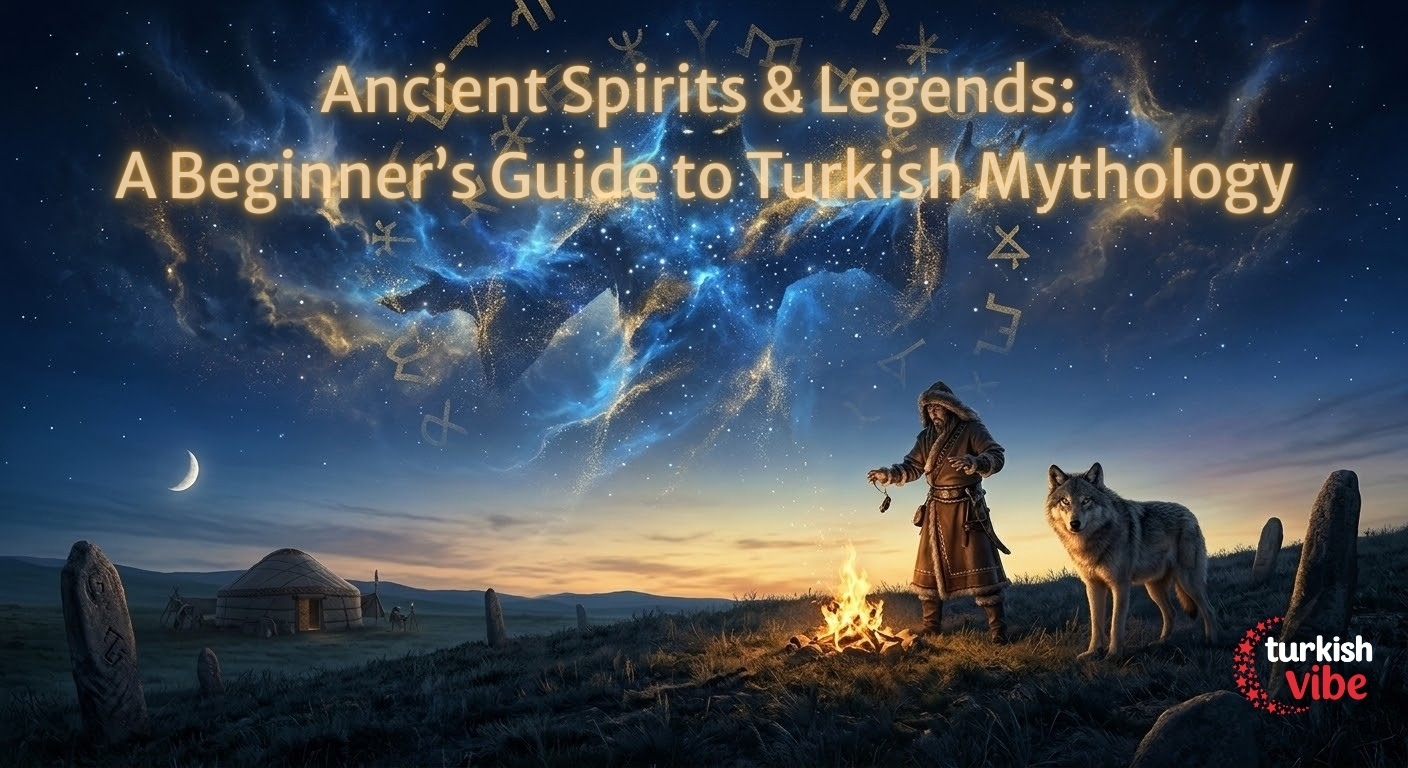
Turkish culture is often celebrated for its Ottoman history, vibrant bazaars, and mouth-watering cuisine. However, long before the rise of empires in Anatolia, the ancestral Turkic tribes of Central Asia developed a rich, complex, and deeply spiritual mythological system.
This isn’t just a collection of old stories; it is the foundational worldview that shaped the Turkic soul. If you want to truly understand the resilience, nature-worship, and warrior spirit of the Turkish people today, you must explore the legends of the vast Eurasian Steppe.
Welcome to your essential beginner’s guide to the forgotten gods, sacred beasts, and epic tales of Turkish mythology.
The Foundation: Tengrism and the Eternal Sky God
Before Islam or Christianity reached the Turkic steppes, the ancient Turks practiced a belief system known as Tengrism. It was not a religion in the modern sense but a holistic philosophy centered on living in harmony with nature and the cosmos.
1. Tengri (The Sky God)
At the pinnacle of this pantheon is Tengri (also known as Kök Tengri or Sky God). Tengri is the supreme, eternal, and singular deity who created the universe.
What Tengri Represents: Unlike the humanoid gods of Greek or Roman mythology, Tengri was often perceived as the vast, infinite blue sky itself. Tengri is the source of all life, order, and cosmic balance.
The Concept of ‘Kut’: Türkic rulers (Khagans) believed their right to rule was granted directly by Tengri through a divine life force called ‘Kut’. If a ruler lost his ‘Kut’, it was believed his empire would fall—a concept that driven countless epic battles in Turkish history.
(Learn more about how this belief system influences modern Turkish People Lifestyle.)
2. Umay (The Earth Goddess)
While Tengri ruled the heavens, Umay was the beloved goddess of the earth, fertility, and protection.
Her Role: Umay is the protector of women, children, and the home. Ancient Turkic people believed that Umay protected babies in the womb and guided them safely into the world.
Symbolism: She is often depicted as a benevolent mother figure, sometimes associated with water and the life-giving forces of nature. (You might remember her name from our Turkish Names Guide as a popular modern-traditional hybrid choice).
Did You Know? The phrase “Gök Tanrı” (Sky God) is still commonly used in modern Turkish today when someone looks up at the sky in times of awe, hope, or desperation, showing how deeply this ancestral deity is embedded in the cultural subconscious.

The Three Realms of Existence
In Turkic mythology (or Turkish mythology), the universe is not just a flat space; it is divided into three distinct yet connected layers:
The Upper World (Sky): The realm of Tengri and benevolent spirits (Ayıı). It is a place of pure light and eternal peace.
The Middle World (Earth): Where humans, animals, and nature spirits (Edis) reside. This is the realm of balance.
The Lower World (Underworld): The domain of Erlik Khan. However, unlike the Western “Hell,” it was seen as a place of transformation and the source of certain earthly trials.
Sacred Creatures and Legendary Beasts of the Steppe
The vast Eurasian steppes were not just home to warriors and nomads; they were a mystical landscape filled with sacred beasts and mythical creatures, each representing a unique force of nature and the Turkic soul.
1. Asena (The Divine She-Wolf)
Of all the legendary creatures, none is more revered than Asena, the mythical she-wolf. She is the progenitor of the Göktürks (or Ashina clan), the first great Turkic Empire.
The Legend: According to ancient tales, after a catastrophic war that nearly wiped out the Turkic people, only one boy survived. He was rescued and nursed by a miraculous she-wolf. Asena raised him and bore his ten sons, who founded the powerful Ashina lineage.
Why It Matters Today: The she-wolf remains the ultimate symbol of Turkic identity, resilience, and independence. You can see this icon reflected in many aspects of modern Turkish People values. (And you might remember it as a popular choice in our Turkish Names Guide).
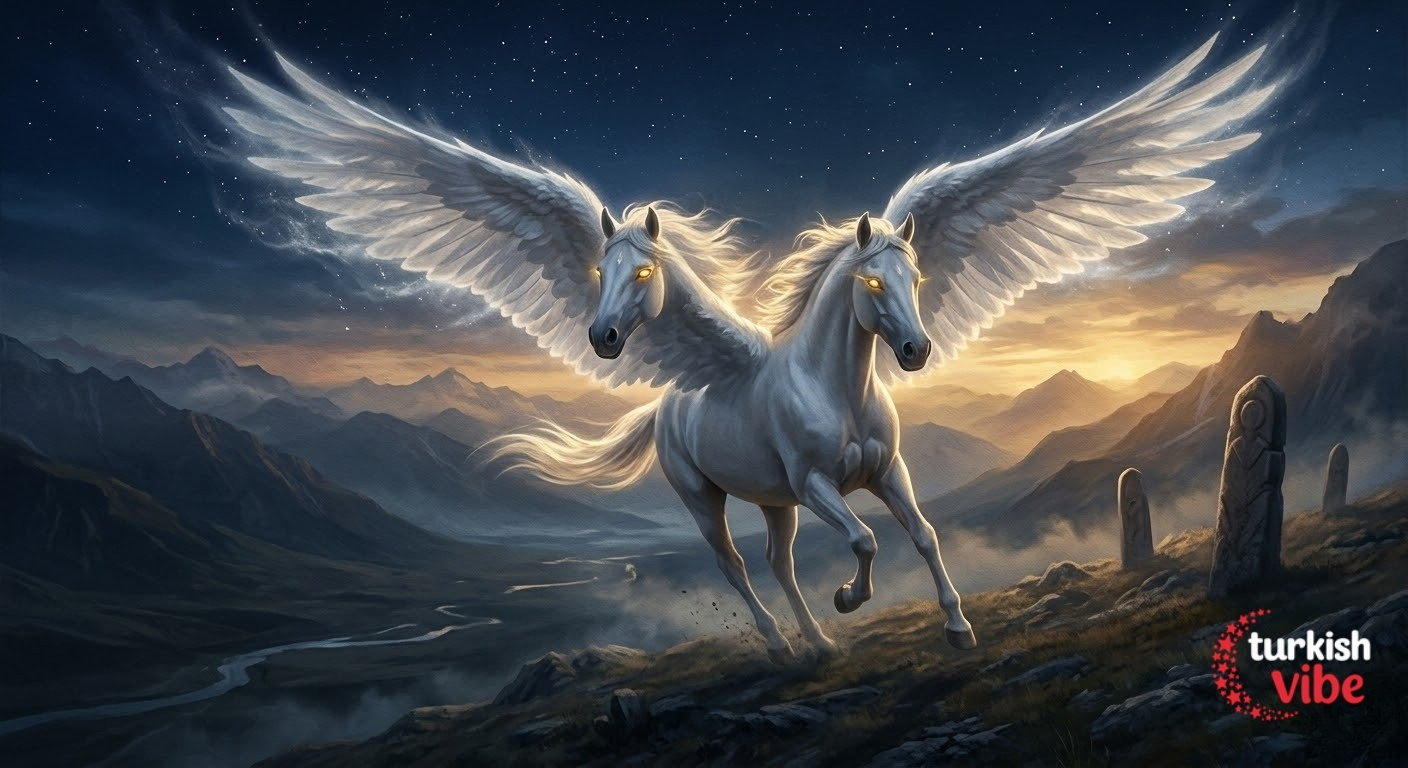
2. Tulpar (The Winged Horse)
What Pegasus is to Greek mythology, the Tulpar is to the Turkish mythology—but with a unique nomadic twist.
His Role: The Tulpar is a sacred, swift, and winged horse, believed to guide the spirits of heroes and shamans through the sky. He is often depicted as a warrior’s loyal companion, symbolizing speed, freedom, and the bridge between worlds.
Symbolism: Tulpar represents the deeply ingrained nomadic respect for horses, which were seen as essential for survival and spiritual elevation.
The Secret of Tulpar’s Wings
Legend says that a Tulpar’s wings are invisible to the human eye. They only appear when the horse is galloping at top speed across the vast steppes or when it is soaring through the spiritual dimensions. It is also believed that if a human sees a Tulpar’s wings, the horse will vanish forever—symbolizing that some spiritual powers must remain hidden to be preserved.
3. Erlik Khan (The God of the Underworld)
Every great mythology has its darkness, and in Turkish mythlogy, it is Erlik Khan. He is the chaotic and powerful brother of Tengri, ruling the yeraltı (underworld).
His Realm: Erlik represents the trials, darkness, and forces that test human endurance. He is often depicted in art with a horse’s head or a bull’s face, adding to his formidable image.
Shamanic Perspective: Erlik is not seen as “pure evil” but rather a necessary part of the cosmic balance, challenging heroes and teaching resilience.
Meric and the Guardian Spirits
Beyond the famous beasts, the ancient Turks believed every mountain, river, and forest had a protector spirit known as “İyeler”.
Su İyesi (Water Spirit): Guardians of the rivers and lakes, often depicted as beautiful yet dangerous beings.
Orman İyesi (Forest Spirit): The protector of the woods, ensuring that hunters only took what they needed to survive, enforcing an early form of environmental ethics.
The Tree of Life (Hayat Ağacı)
The Baiterek: The Sacred Tree of Life
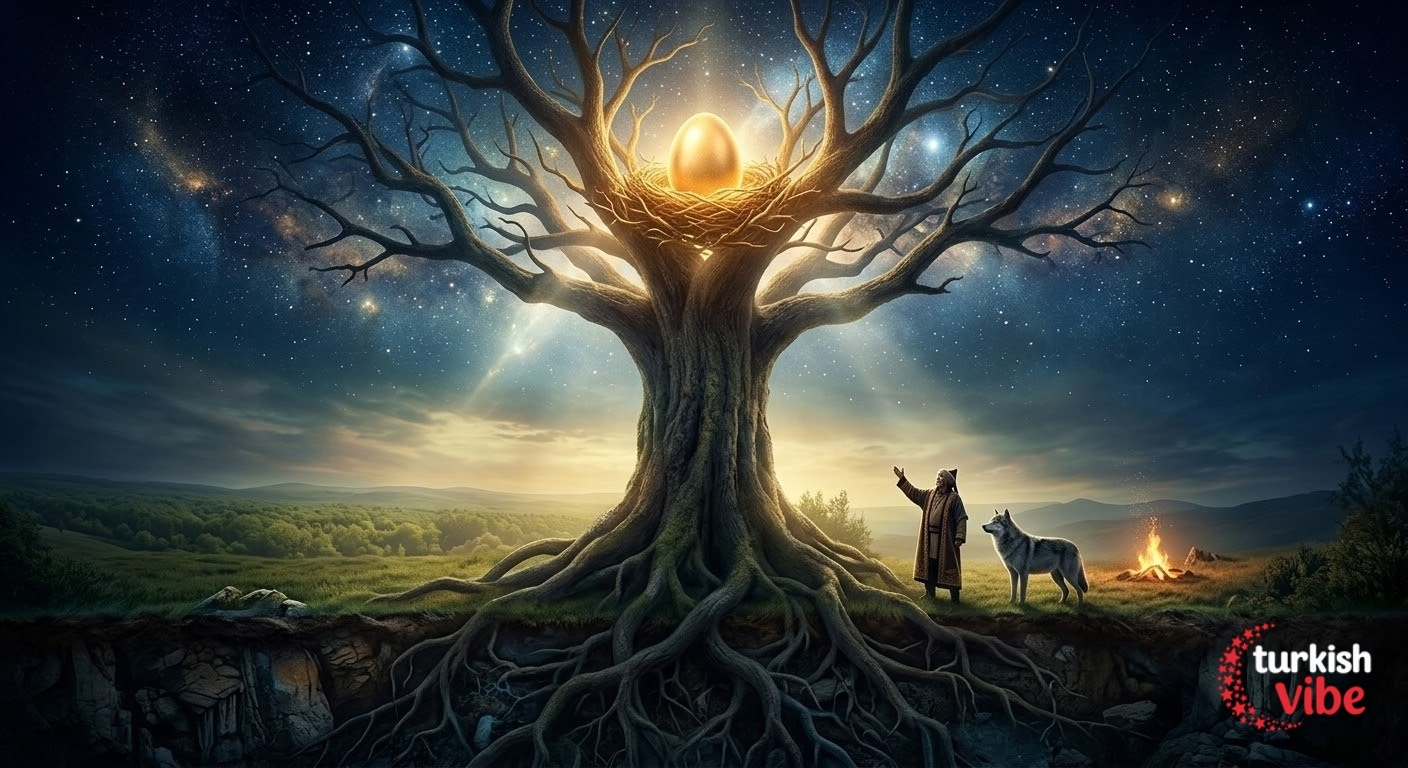
At the very core of ancient Turkic cosmology stands the Baiterek, the monumental Tree of Life. It is not just a tree; it is the cosmic axis, the very connection between the Upper, Middle, and Lower Worlds, serving as the source of all existence and renewal. The tree is another motif as important as the wolf in Turkish mythology.
1. The Divine Structure: Connecting the Three Worlds
The Baiterek’s structure perfectly mirrors the three realms of existence we explored earlier:
The Roots (The Lower World): Its deep, ancient roots penetrate the underworld, where Erlik Khan resides. This symbolizes the source of life emerging from the deep past and the transformation of the ancestors.
The Trunk (The Middle World): The immense trunk supports the entire human realm, acting as a direct channel of divine energy from the sky. It represents stability and the connection of all living things.
The Branches (The Upper World): Its expansive branches spread across the cosmos, touching the realm of Tengri. This signifies growth, infinity, and spiritual elevation.
2. The Golden Egg: The Symbol of Cosmic Renewal
One of the most powerful symbols in Turkish mythology is centered at the top of the Baiterek.
Did You Know? Every year, the mythical bird Simurgh (or Konrul), which nests in the branches, lays a single Golden Egg. This egg represents the sun and the cyclical renewal of life, guaranteed to bring spring, light, and warmth back to the steppes. It is a symbol of absolute hope and the triumph of life over darkness.
3. Shamanic Rituals and the Sacred Tree
The Baiterek was not just a philosophical concept; it was actively revered in Turkic spiritual practices.
A Shaman’s Ladder: When a shaman performed a ritual to travel to the Upper World to speak with Tengri or seek guidance from benevolent spirits, they believed their spirit would ascend via the spiritual dimensions of the Baiterek, treating it as a literal ladder to the divine.
Prayers and Sacrifices: Nomadic Turkic clans often held important gatherings and performed rituals near what they perceived as a powerful local tree, treating it as a proxy for the Baiterek and a direct line of communication to Gök Tanrı.
Modern Echoes: Mythology in Today’s Turkey
The ancient gods may have retreated into the stars, but their symbols and stories are still very much alive in the daily life, art, and traditions of modern Turkey. Traces of Turkish mythology in the present day:
The Nazar Boncuğu (Evil Eye): While often associated with various cultures, the blue eye bead has deep roots in Tengrist beliefs, where blue was the sacred color of the Sky God. It remains the most popular symbol of protection in Turkey today. (Check out the content we’ve prepared about the Evil Eye Bead: Turkish Evil Eye.)
Carpet Motifs: If you look closely at traditional Turkish rugs (kilims), you will see geometric patterns representing the “Dragon” or the “Wolf’s Track.” These are not just decorations; they are ancient spiritual shorthand for protection and strength.
The Tree of Life: The symbol of the Hayat Ağacı can be found in everything from modern architecture to the intricate embroidery of traditional dresses, symbolizing the connection between the earth, humanity, and the divine.
Frequently Asked Questions About Turkish Mythology
Who is the supreme god in Turkish mythology?
The supreme and singular deity in ancient Turkic belief is Tengri (the Sky God). He is the eternal creator of the universe, representing cosmic balance and the infinite blue sky. Unlike the humanoid gods of other mythologies, Tengri was often perceived as the sky itself.
What does the wolf (Asena) symbolize for Turks?
The she-wolf Asena is the most sacred symbol of Turkic identity. According to legend, she rescued the last survivor of a massacre and gave birth to the ancestors of the Göktürks. Today, she symbolizes resilience, rebirth, and the independent spirit of the Turkish people.
What is a Tulpar in ancient legends?
A Tulpar is a mythical winged horse found in Turkic and Central Asian mythology. Similar to Pegasus, it represents speed and freedom. In nomadic culture, the Tulpar was believed to be a warrior’s loyal spiritual companion, able to fly through the celestial realms.
Is there a “bad” spirit or god in Turkish mythology?
Yes, the most prominent figure is Erlik Khan, the ruler of the underworld. However, in Tengrism, Erlik is not seen as “pure evil” but as a necessary part of the cosmic balance. He represents the challenges and trials that test human character and strength.
How does ancient mythology influence modern Turkish life?
Ancient Turkic symbols are still woven into the fabric of modern Turkey. The Nazar Boncuğu (Evil Eye) stems from the sacred blue color of Tengri, and the Baiterek (Tree of Life) remains a major motif in Turkish art, carpets (kilims), and architectural designs.